
Yellow Road Signs Meaning
Yellow signs warn of something ahead. Here is each warning sign, what it means and how to react.
24 signs shown
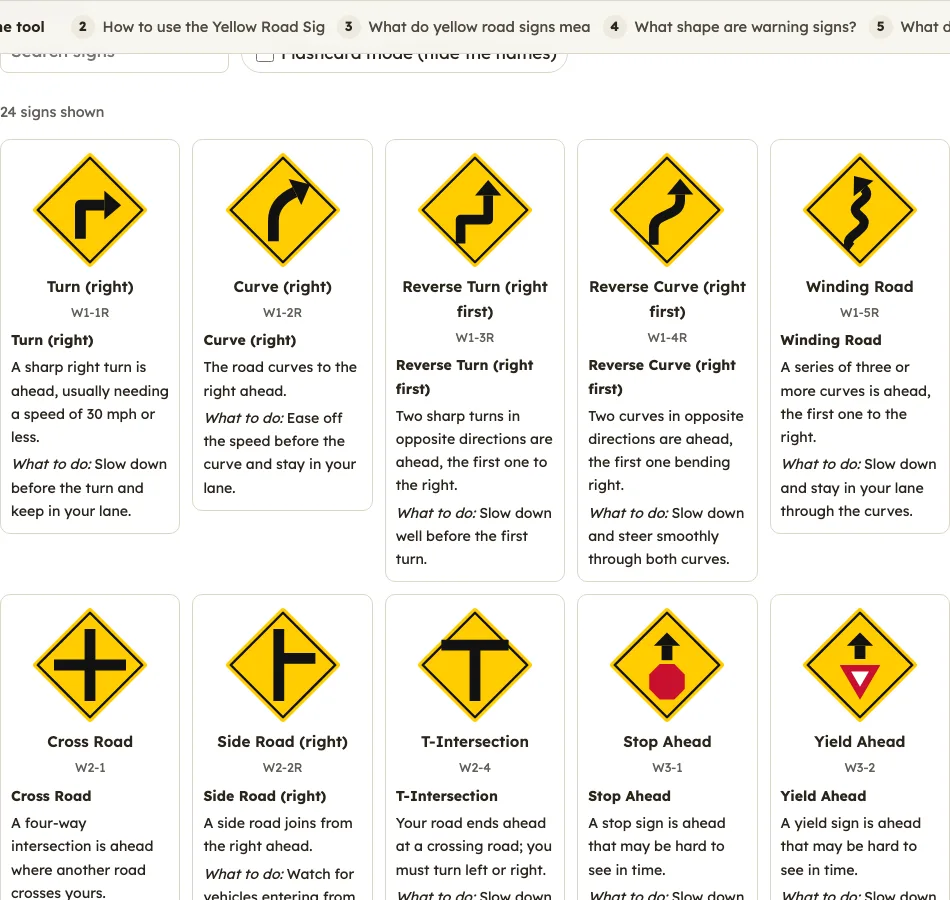
Turn (right)
A sharp right turn is ahead, usually needing a speed of 30 mph or less.
What to do: Slow down before the turn and keep in your lane.
Curve (right)
The road curves to the right ahead.
What to do: Ease off the speed before the curve and stay in your lane.
Reverse Turn (right first)
Two sharp turns in opposite directions are ahead, the first one to the right.
What to do: Slow down well before the first turn.
Reverse Curve (right first)
Two curves in opposite directions are ahead, the first one bending right.
What to do: Slow down and steer smoothly through both curves.
Winding Road
A series of three or more curves is ahead, the first one to the right.
What to do: Slow down and stay in your lane through the curves.
Cross Road
A four-way intersection is ahead where another road crosses yours.
What to do: Slow down and watch for vehicles entering or crossing.
Side Road (right)
A side road joins from the right ahead.
What to do: Watch for vehicles entering from the right.
T-Intersection
Your road ends ahead at a crossing road; you must turn left or right.
What to do: Slow down and prepare to stop or turn.
Stop Ahead
A stop sign is ahead that may be hard to see in time.
What to do: Slow down and prepare to stop.
Yield Ahead
A yield sign is ahead that may be hard to see in time.
What to do: Slow down and be ready to yield or stop.
Signal Ahead
A traffic signal is ahead that may be hard to see in time.
What to do: Slow down and be ready to stop for the signal.
Merge
Traffic from another roadway joins your lane ahead.
What to do: Watch for merging vehicles and adjust speed so both can merge safely.
Right Lane Ends
The right lane ends ahead and its traffic must merge left.
What to do: If in the right lane, merge left early; otherwise let merging drivers in.
Road Narrows
The road gets narrower ahead.
What to do: Slow down and keep right; watch for oncoming traffic.
Divided Highway
A median or divider begins ahead and separates the two directions of traffic.
What to do: Keep to the right of the divider.
Divided Highway Ends
The divider ends ahead and two-way traffic shares one road.
What to do: Keep right and watch for oncoming traffic.
Slippery When Wet
The road surface ahead can become slippery when it is wet.
What to do: Slow down in wet weather and avoid sudden braking or steering.
Pedestrian Crossing
People on foot may be crossing the road ahead.
What to do: Slow down, watch for pedestrians, and yield to them in crosswalks.
Bicycle
Bicyclists may be crossing or riding on the road ahead.
What to do: Slow down, watch for cyclists, and give them room.
Deer Crossing
Deer often cross the road in this area.
What to do: Slow down and scan the roadsides, especially at dawn and dusk.
No Passing Zone
A no-passing zone begins here; it is mounted on the left side of the road.
What to do: Do not start passing other vehicles.
Dead End
This road ends ahead with no way through.
What to do: Expect to turn around; do not use it as a through route.
No Outlet
This road and its side streets have no other exit.
What to do: Expect to come back out the same way.
Hill (with grade)
A steep downgrade is ahead; the percentage shows how steep it is.
What to do: Slow down, use a lower gear, and check your brakes.
Drawings by Permitnook after the federal standard: MUTCD 11th edition (FHWA, December 2023).
Free · runs in your browser · nothing is uploaded · Permitnook is not affiliated with any DMV or government agency, and practice questions are not the real test questions.
How to use the Yellow Road Signs Meaning Tool
- Look at the colour and shape first. A yellow or fluorescent yellow-green diamond is a warning sign.
- Read the symbol or words on the sign. An arrow or a bending line shows the direction of the hazard.
- Find the sign in the tool above, or check the table in the next section for its name and code.
- Read the “what to do” line for that sign and apply it as you approach.
- Notice which side the sign is on. For example, a Side Road (right) sign means the road joins from your right.
The tool above is the place to start. This page doesn’t describe any printing, sharing or shortcut options, so it sticks to what each sign means and what to do when you see it.
Use the group buttons to narrow the chart to one kind of sign, and the search box to find a sign by name, code or a word from its meaning. In Flashcard mode, tap a card to show its name, meaning and action, and tap again to hide it. The chart pages save nothing; the quiz pages keep your results in your browser.
What do yellow road signs mean?
Yellow road signs are general warning signs. They tell you that a hazard or a change in the road is ahead, such as a sharp turn, a merge or a crossing road. The symbol on the sign tells you what kind of hazard to expect.
| Sign | What is ahead | What to do |
|---|---|---|
| Turn (right) W1-1R | Sharp right turn, usually 30 mph or less | Slow down before the turn and keep in your lane |
| Curve (right) W1-2R | Road curves to the right | Ease off speed before the curve |
| Cross Road W2-1 | Four-way intersection | Slow down and watch for crossing vehicles |
| Merge W4-1 | Traffic from another roadway joins your lane | Watch for merging vehicles and adjust speed |
| Deer Crossing W11-3 | Deer often cross in this area | Scan the roadsides, especially at dawn and dusk |
| Hill (with grade) W7-1a | Steep downgrade | Slow down, use a lower gear, and check your brakes |
What shape are warning signs?
Warning signs are yellow diamonds in general. The diamond shape marks a hazard or change in the road ahead. Two warning signs use other shapes: the railroad advance warning sign is a circle, and the No Passing Zone sign is a pennant.
What do orange and fluorescent yellow-green signs mean?
Orange signs mark temporary traffic control, such as road work zones. Fluorescent yellow-green signs warn about people and vehicles that need extra room, including pedestrians, bicycles, playgrounds, school buses and schools. Pedestrian Crossing (W11-2) and Bicycle (W11-1) are examples of these warnings.
| Colour | Meaning |
|---|---|
| Yellow | General warning |
| Fluorescent yellow-green | Pedestrians, bicycles, playgrounds, school buses and schools |
| Orange | Temporary traffic control, such as road work zones |
| Red | Stop or prohibition, such as STOP and YIELD |
What does a pennant-shaped sign mean?
A pennant-shaped sign is a sideways triangle, and it is used only for the No Passing Zone sign. That sign is mounted on the left side of the road and marks a stretch where passing is not allowed. When you see this shape, do not start passing other vehicles.
Frequently asked questions
Does every yellow sign mean I have to stop?
No. Yellow warning signs say a hazard is ahead and ask you to slow down or prepare. Only the STOP sign uses an octagon, and it is red.
Is a Stop Ahead sign the same as a stop sign?
No. Stop Ahead (W3-1) warns that a stop sign is ahead and may be hard to see in time. Slow down and prepare to stop when you see it.
What does a Dead End sign mean?
It means the road ends ahead with no way through. Expect to turn around, and do not use the road as a through route.
Why do some school signs look a different colour?
School and pedestrian warning signs use fluorescent yellow-green, which sets them apart from standard yellow warnings. You can read more on the school zone signs page.
Are all warning signs yellow?
No. Warning signs are yellow in general, but school and pedestrian warning signs use fluorescent yellow-green and work zone signs are orange. Most warning signs are diamonds, with the round railroad sign and the pennant-shaped No Passing Zone sign as exceptions.
Which yellow sign should I learn first?
Start with Stop Ahead, Yield Ahead, Signal Ahead and the curve and turn signs, because they tell you to slow down before a decision point.
Related tools
- All road sign meanings: Use it when you need the meaning of a sign that is not yellow.
- Road signs test: Use it to check how well you know the signs after reading this guide.
- School zone signs: Use it when you are driving near a school or a crossing where children are present.
- Railroad crossing signs: Use it to learn the circle warning and crossbuck signs at rail crossings.
- Permit practice test: Use it to practise the kinds of questions that cover road signs.
- Permit tests by state: use it to pick your state from all nine state tests.