
Road Sign Meanings
Every sign with its meaning and the action it asks for. Switch on flashcards to test yourself.
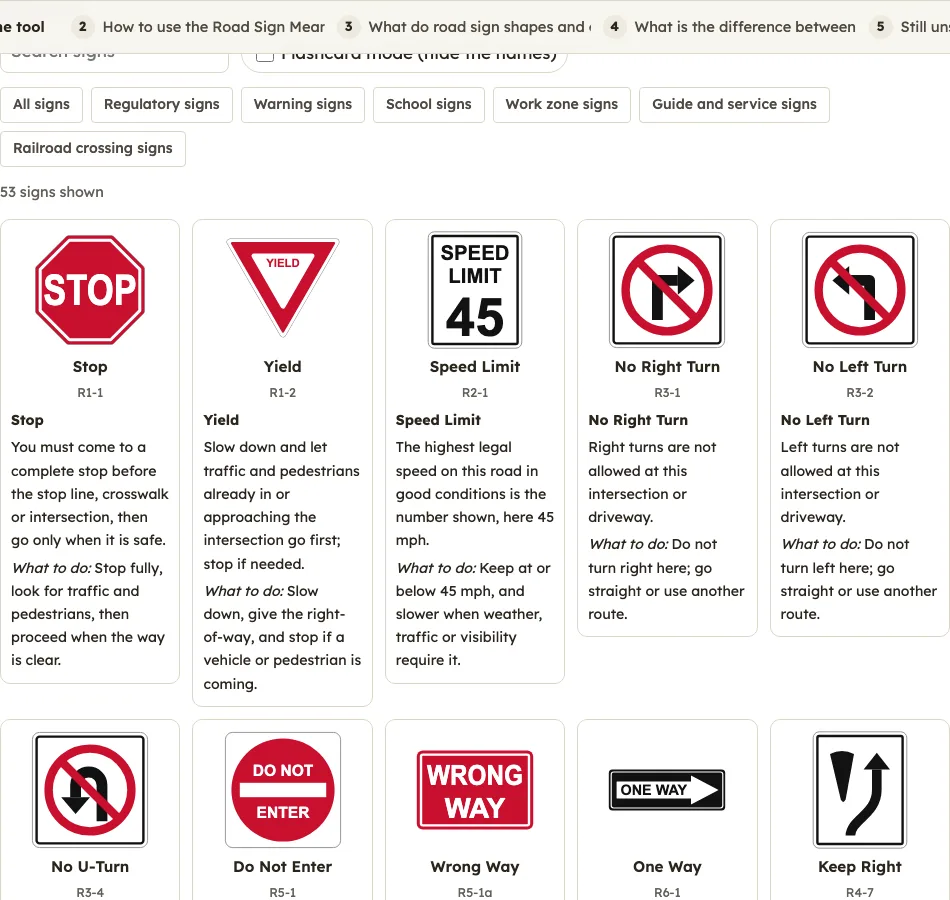
53 signs shown
Stop
You must come to a complete stop before the stop line, crosswalk or intersection, then go only when it is safe.
What to do: Stop fully, look for traffic and pedestrians, then proceed when the way is clear.
Yield
Slow down and let traffic and pedestrians already in or approaching the intersection go first; stop if needed.
What to do: Slow down, give the right-of-way, and stop if a vehicle or pedestrian is coming.
Speed Limit
The highest legal speed on this road in good conditions is the number shown, here 45 mph.
What to do: Keep at or below 45 mph, and slower when weather, traffic or visibility require it.
No Right Turn
Right turns are not allowed at this intersection or driveway.
What to do: Do not turn right here; go straight or use another route.
No Left Turn
Left turns are not allowed at this intersection or driveway.
What to do: Do not turn left here; go straight or use another route.
No U-Turn
Turning around to go back the way you came is not allowed here.
What to do: Do not make a U-turn; continue and turn around legally elsewhere.
Do Not Enter
Traffic may not enter this road or ramp from your direction, usually because it is one-way the other way.
What to do: Do not drive in; find another route.
Wrong Way
You are driving against the flow of traffic on a one-way road or ramp.
What to do: Stop safely, turn around or pull off, and leave the way you came.
One Way
Traffic on this street moves only in the direction of the arrow.
What to do: Drive or turn only in the direction the arrow points.
Keep Right
An island, median or obstruction is ahead; traffic must pass to the right of it.
What to do: Stay to the right of the island or divider.
Do Not Pass
Passing other vehicles is not allowed on this stretch of road.
What to do: Stay in your lane behind slower vehicles until passing is allowed.
Pass With Care
The no-passing zone has ended; you may pass when it is safe.
What to do: Pass only when the oncoming lane is clear and passing is legal.
No Parking Any Time
Parking is not allowed at any time along the stretch shown by the arrows.
What to do: Do not park here; you may stop only briefly as the law allows.
Reserved Parking (Accessible)
This space is reserved for vehicles displaying a valid disability parking placard or plate.
What to do: Park here only with a valid disability placard or plate.
No Trucks
Trucks are not allowed on this road, usually above a weight or size set by local law.
What to do: If you drive a truck, use another route.
No Pedestrian Crossing
Pedestrians may not cross the road at this point.
What to do: Walkers: use a marked crosswalk. Drivers: expect pedestrians to cross elsewhere.
No Bicycles
Bicycles are not allowed on this road or path.
What to do: Cyclists must use another route.
Grade Crossing (Crossbuck)
Railroad tracks cross the road here; trains have the right-of-way, so treat it like a yield sign.
What to do: Slow down, look and listen both ways, and stop if a train is coming.
Grade Crossing Advance Warning
A railroad crossing is ahead on this road.
What to do: Slow down, look and listen for trains, and be ready to stop.
Turn (right)
A sharp right turn is ahead, usually needing a speed of 30 mph or less.
What to do: Slow down before the turn and keep in your lane.
Curve (right)
The road curves to the right ahead.
What to do: Ease off the speed before the curve and stay in your lane.
Reverse Turn (right first)
Two sharp turns in opposite directions are ahead, the first one to the right.
What to do: Slow down well before the first turn.
Reverse Curve (right first)
Two curves in opposite directions are ahead, the first one bending right.
What to do: Slow down and steer smoothly through both curves.
Winding Road
A series of three or more curves is ahead, the first one to the right.
What to do: Slow down and stay in your lane through the curves.
Cross Road
A four-way intersection is ahead where another road crosses yours.
What to do: Slow down and watch for vehicles entering or crossing.
Side Road (right)
A side road joins from the right ahead.
What to do: Watch for vehicles entering from the right.
T-Intersection
Your road ends ahead at a crossing road; you must turn left or right.
What to do: Slow down and prepare to stop or turn.
Stop Ahead
A stop sign is ahead that may be hard to see in time.
What to do: Slow down and prepare to stop.
Yield Ahead
A yield sign is ahead that may be hard to see in time.
What to do: Slow down and be ready to yield or stop.
Signal Ahead
A traffic signal is ahead that may be hard to see in time.
What to do: Slow down and be ready to stop for the signal.
Merge
Traffic from another roadway joins your lane ahead.
What to do: Watch for merging vehicles and adjust speed so both can merge safely.
Right Lane Ends
The right lane ends ahead and its traffic must merge left.
What to do: If in the right lane, merge left early; otherwise let merging drivers in.
Road Narrows
The road gets narrower ahead.
What to do: Slow down and keep right; watch for oncoming traffic.
Divided Highway
A median or divider begins ahead and separates the two directions of traffic.
What to do: Keep to the right of the divider.
Divided Highway Ends
The divider ends ahead and two-way traffic shares one road.
What to do: Keep right and watch for oncoming traffic.
Slippery When Wet
The road surface ahead can become slippery when it is wet.
What to do: Slow down in wet weather and avoid sudden braking or steering.
Pedestrian Crossing
People on foot may be crossing the road ahead.
What to do: Slow down, watch for pedestrians, and yield to them in crosswalks.
Bicycle
Bicyclists may be crossing or riding on the road ahead.
What to do: Slow down, watch for cyclists, and give them room.
Deer Crossing
Deer often cross the road in this area.
What to do: Slow down and scan the roadsides, especially at dawn and dusk.
No Passing Zone
A no-passing zone begins here; it is mounted on the left side of the road.
What to do: Do not start passing other vehicles.
Dead End
This road ends ahead with no way through.
What to do: Expect to turn around; do not use it as a through route.
No Outlet
This road and its side streets have no other exit.
What to do: Expect to come back out the same way.
Hill (with grade)
A steep downgrade is ahead; the percentage shows how steep it is.
What to do: Slow down, use a lower gear, and check your brakes.
School
You are entering a school area or school zone where children may be present.
What to do: Slow down, obey any school speed limit, and watch for children.
School Crossing
Children cross the road at this crosswalk; the arrow plaque points to the crossing.
What to do: Slow down and stop for children in the crosswalk.
School Speed Limit When Flashing
A lower school speed limit applies when the attached yellow lights are flashing.
What to do: When the lights flash, keep to the posted school speed.
School Bus Stop Ahead
A school bus stops ahead where it may be hidden from view until you are close.
What to do: Slow down and be ready to stop for a stopped school bus.
Road Work Ahead
A work zone is ahead; workers, equipment or lane changes may be on the road.
What to do: Slow down, obey work-zone signs and flaggers, and watch for workers.
Flagger
A flagger is ahead directing traffic through the work zone.
What to do: Slow down and follow the flagger’s STOP/SLOW instructions.
Right Lane Closed Ahead
The right lane is closed ahead for work.
What to do: Merge left early and safely, and slow down.
U.S. Route
You are on, or this points to, a U.S. numbered highway; here U.S. Route 66.
What to do: Use it to follow your route number.
Hospital
A hospital with emergency care can be reached from this road.
What to do: Follow the sign (and any arrow plaque) if you need medical help.
Rest Area
A rest area with parking and usually restrooms is ahead at the distance shown.
What to do: Plan to exit there if you need a break; fatigue is dangerous.
Sign shapes and colours
- Octagon (8 sides): Used only for the STOP sign.
- Downward-pointing triangle: Used only for the YIELD sign.
- Circle: Used only for the railroad crossing advance warning sign.
- Pennant (sideways triangle): Used only for the NO PASSING ZONE sign, on the left side of the road.
- Pentagon (5 sides, point up): Used for the School sign (and county route markers).
- Crossbuck (X): Used only for the railroad grade crossing sign.
- Diamond: Warning signs: a hazard or change in the road is ahead.
- Rectangle or square: Regulatory and guide signs, plus some warning signs and plaques.
- Red: Stop or prohibition (STOP, YIELD, DO NOT ENTER, the red circle and slash).
- Yellow: General warning.
- Fluorescent yellow-green: Warnings for pedestrians, bicycles, playgrounds, school buses and schools.
- Orange: Temporary traffic control, such as road work zones.
- White: Regulation (rules you must obey), usually with black letters.
- Black: Regulation; also the background of ONE WAY and some night signs.
- Green: Permitted movements and direction guidance.
- Blue: Road-user services, tourist information and evacuation routes.
- Brown: Recreational and cultural interest areas, such as parks.
- Fluorescent pink: Traffic incident management (crash scenes and similar).
- Purple: Lanes only for vehicles with a registered electronic toll account.
Drawings by Permitnook after the federal standard: MUTCD 11th edition (FHWA, December 2023).
Free · runs in your browser · nothing is uploaded · Permitnook is not affiliated with any DMV or government agency, and practice questions are not the real test questions.
A yield sign means slow down, give way to traffic and pedestrians in your path, and stop if you need to. Road sign meanings are set by shape, colour and symbol, and this chart shows all 53 signs with the picture, name, MUTCD designation, meaning and what a driver should do. Use it to look up a sign you saw on the road, or switch on flashcard mode to hide the names and test yourself. The signs fall into six groups: 17 regulatory, 24 warning, 4 school, 3 work zone, 3 guide and service and 2 railroad. A second table lists which shapes and colours the MUTCD reserves for which kind of sign. Permitnook is not affiliated with any DMV or government agency.
Every card has the same layout, so you can scan quickly.
How to use the Road Sign Meanings Chart
- Scroll the chart to see every sign as a card. Each card shows the sign picture, its name, and its MUTCD designation.
- Read the meaning and the “what to do” line on a card to learn the driver’s action.
- Tap a group button (Regulatory, Warning, School, Work Zone, Guide and Service, or Railroad) to show only that group.
- Click the search box and type a sign name, a code such as R1-1, or a word from a meaning, such as “curve.”
- Turn on flashcard mode. The names are hidden, so look at each sign and try to say what it means.
- Tap a sign to reveal its name, meaning, and what to do.
- Tap the same sign again to hide its name, then move on to the next one.
The group buttons and the search box are the two ways to narrow the chart. Start with one group, such as Regulatory, and use flashcard mode to check yourself before you move to the next group.
Use the group buttons to narrow the chart to one kind of sign, and the search box to find a sign by name, code or a word from its meaning. In Flashcard mode, tap a card to show its name, meaning and action, and tap again to hide it. The chart pages save nothing; the quiz pages keep your results in your browser.
What do road sign shapes and colors mean?
Shape and color tell you what kind of message a sign carries before you read a word. The MUTCD reserves certain shapes for specific signs, so a sign with an octagon is always a STOP sign. Red signals a stop or a prohibition, yellow a general warning, and white a rule you must obey.
The MUTCD reserves these shapes:
| Shape | Used for |
|---|---|
| Octagon (8 sides) | Only the STOP sign |
| Downward-pointing triangle | Only the YIELD sign |
| Circle | Only the railroad crossing advance warning sign |
| Pennant (sideways triangle) | Only the NO PASSING ZONE sign, on the left side of the road |
| Pentagon (5 sides, point up) | The School sign and county route markers |
| Crossbuck (X) | Only the railroad grade crossing sign |
| Diamond | Warning signs: a hazard or change is ahead |
| Rectangle or square | Regulatory and guide signs, plus some warning signs and plaques |
Colors work the same way. Orange marks temporary road work, fluorescent yellow-green marks school and pedestrian areas, green gives directions, and blue points to services such as hospitals and rest areas.
Take the Speed Limit sign (R2-1). It is a white rectangle with black letters, so you know it is a rule. The number shown, here 45 mph, is the highest legal speed in good conditions. The MUTCD is the federal standard that states adopt or adapt, so a state handbook can differ on details. For a state test, use that handbook as your reference.
What is the difference between a warning sign and a regulatory sign?
A regulatory sign tells you what the law requires or forbids, and you must obey it. A warning sign tells you that a hazard or change in the road is ahead, so you should prepare for it. Regulatory signs are mostly white rectangles, while warning signs are usually yellow diamonds.
The two groups can address the same situation from different angles. The Stop sign (R1-1) is a regulation: you must come to a complete stop. The Stop Ahead sign (W3-1) is a warning: a stop sign is coming and may be hard to see in time, so slow down and get ready to stop.
Frequently asked questions
What does a yield sign mean on the permit test?
Slow down, give way to traffic and pedestrians that have the right of way, and stop if needed before you go on. The red and white downward-pointing triangle is the only sign with that shape. Sign meanings checked against the MUTCD on 2026-11-13.
What are the main groups of road signs?
The chart sorts signs into six groups: regulatory, warning, school, work zone, guide and service, and railroad crossing. Regulatory signs state rules, warning signs flag hazards, and the other four groups cover school areas, temporary work zones, directions and services, and railroad crossings.
How do I learn road signs quickly?
Start with one group at a time, using the group buttons to narrow the chart. Then switch on flashcard mode, look at each sign, and say its meaning and action before you tap to check. Regulatory signs are a good first group because the shape and red color of the most important ones stand out.
Who decides what road signs look like?
The Federal Highway Administration publishes the MUTCD, the federal standard that sets the shapes, colors, and meanings of road signs. States adopt or adapt it, so signs can differ slightly from one state to another. The signs on this chart are drawn by Permitnook after the 11th edition of the MUTCD, published by the FHWA in December 2023.
Do road sign meanings change from state to state?
The core meanings stay the same, because the MUTCD sets them for the whole country. States can adopt or adapt details, so a rule in your state’s handbook can differ from what the chart shows. When in doubt, follow your state handbook.
Which signs should I slow down for in work zones?
Orange signs mark temporary road work, flaggers, and lane closures. Slow down when you see them, and follow them over normal signs. Use the Work Zone group button to see all three work zone signs on the chart.
Related tools
- Road signs test: Use it to check what you know about road signs after you have studied the chart.
- Yellow warning signs: Use it when you want to focus on the yellow diamond warning signs.
- School zone signs: Use it to learn the fluorescent yellow-green signs near schools and school bus stops.
- Railroad crossing signs: Use it to review the round advance warning sign and the crossbuck.
- Permit practice test: Use it to practice questions for your learner’s permit exam.
- Permit tests by state: use it to pick your state from all nine state tests.