
Right of Way Test
Pick your state and answer only right-of-way questions: who goes first, who yields, and why.
Free · runs in your browser · nothing is uploaded · Permitnook is not affiliated with any DMV or government agency, and practice questions are not the real test questions.
How to use the Right of Way Test
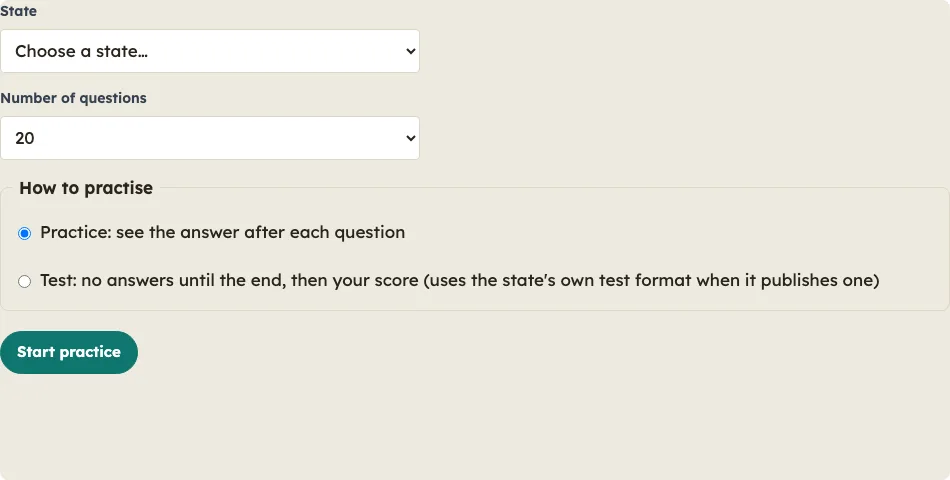
- Choose your state from the setup at the top of the page.
- Pick how many questions you want: 10, 20, 30, 40 or all.
- Select Practice or Test.
- Start the quiz and answer each question.
- In Practice mode, read the feedback after each answer: whether it was right, the correct answer, the explanation and the handbook link.
- In Test mode, use the Back button to change an earlier answer before you finish.
- Read the result screen: your score as “X of N right (P%)”, a pass or fail line if your state publishes a pass mark, your score by topic (weakest first), and every missed question.
The topic is fixed to right of way on this page, so you do not need to tick any topic boxes. Use Retry the ones I missed to repeat only the questions you got wrong, or Print results to keep a copy. Missed questions are saved in your browser, and “Review my N missed questions” starts a quiz that puts them first.
After a run, open My progress to see how many different questions you have seen and which ones are waiting for review. A question you miss comes back first in your next quiz and leaves the list after two correct answers in a row. Print results keeps a paper copy of the score and the missed questions.
Who has the right of way at a four-way stop?
At a four-way stop, the vehicle that reaches the intersection first goes first. When drivers arrive at the same time, the driver on the left yields to the driver on the right. New York and Florida both state this rule. Stop completely at the line before you move.
New York’s handbook applies it to drivers stopping at STOP signs at the same time at right angles. Florida’s handbook says to treat the intersection as a four-way stop.
Who has the right of way at an uncontrolled intersection?
With no signs or signals, the answer depends on your state’s rule. North Carolina gives the right of way to the vehicle on the right when vehicles arrive at the same time. California gives priority to traffic going straight on the through road at a T intersection, and the side road must wait.
| State | Situation | Who goes first |
|---|---|---|
| North Carolina | Vehicles arrive at the same time | The vehicle to the right |
| California | T intersection, no STOP or YIELD signs | Traffic going straight on the through road |
| New York | Drivers at STOP signs arrive at the same time at right angles | The driver on the right |
When must I yield to pedestrians?
You must yield to pedestrians in or entering a crosswalk, and some states are stricter than others. Kentucky’s handbook says to yield to all pedestrians in the intersection even on a green light. Georgia requires you to stop and stay stopped while pedestrians are in the crosswalk, not just slow down.
- Tennessee: for a blind pedestrian crossing the roadway, stop at least 10 feet away until the person is off the road.
- Illinois: in an unmarked crosswalk with no traffic signals, yield to a pedestrian on your side of the roadway.
- Turning drivers yield to pedestrians lawfully in the crosswalk, even on a green light.
What do I do when an emergency vehicle approaches?
Yield to the emergency vehicle and let it pass. In Kentucky, flashing red or blue lights or a siren require you to yield, while white or yellow lights do not. In Tennessee, a siren, air horn, or red or blue flashing light gives emergency vehicles the right of way.
On a highway with at least two lanes going your direction, North Carolina requires you to move out of the lane nearest a stopped emergency vehicle.
Do right-of-way rules differ by state?
Yes. Each state sets its own rules in its driver handbook, so the same situation can have different answers. Georgia requires a driver at a stop sign to yield to any vehicle or pedestrian in or dangerously close to the intersection. California’s rule at a T intersection instead gives priority to the through road. Always check the rule for the state you are testing in.
Frequently asked questions
Does a green light always give me the right of way?
No. A green light does not give an absolute right of way. Turning drivers must still yield to pedestrians lawfully in the crosswalk and to vehicles already in the intersection. Your state’s traffic laws apply as well.
Will Test mode show me the right answer as I go?
No. Test mode shows nothing until the end, so you can use the Back button to change answers. Practice mode shows the correct answer and explanation after each question.
Are my scores sent to the website?
No. Scores, answers and missed questions stay in your browser’s local storage and are never sent to the site. You can delete them on the My progress page.
When does a missed question leave the list?
A missed question leaves the list after you answer it correctly two times in a row. Until then, it appears first in your next normal quiz.
Does a green light always give me the right of way?
No. Even on green, a driver must yield to vehicles and pedestrians already in the intersection, and the state handbook lists further cases. The questions on this page ask these cases one at a time and point to the handbook section.
Why are there no answers in Test mode until the end?
Test mode hides whether each answer is right so you can see how you do without hints. Practice mode shows the answer, the explanation and the handbook section after every question, which is better for learning a new rule.
Related tools
- Practice by topic: use this when you want questions on a subject other than right of way, such as speed or parking.
- DMV practice test by state: use this to take a full practice test built for your state’s DMV.
- Road signs test: use this to check that you can identify regulatory, warning and guide signs.
- Permit practice test: use this to prepare for a learner’s permit test across several topics.
- Railroad crossing signs: use this to learn what each railroad crossing sign and signal means.
- Permit tests by state: use it to pick your state from all nine state tests.