
Railroad Crossing Signs
Advance warning sign, crossbuck and the devices at the crossing, with what each tells a driver.
2 signs shown
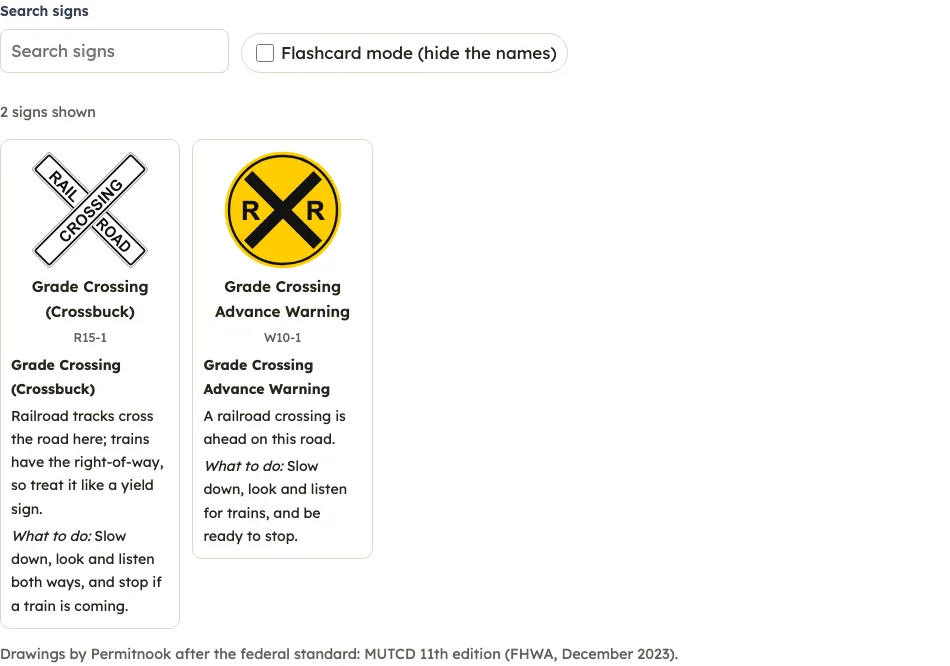
Grade Crossing (Crossbuck)
Railroad tracks cross the road here; trains have the right-of-way, so treat it like a yield sign.
What to do: Slow down, look and listen both ways, and stop if a train is coming.
Grade Crossing Advance Warning
A railroad crossing is ahead on this road.
What to do: Slow down, look and listen for trains, and be ready to stop.
Drawings by Permitnook after the federal standard: MUTCD 11th edition (FHWA, December 2023).
Free · runs in your browser · nothing is uploaded · Permitnook is not affiliated with any DMV or government agency, and practice questions are not the real test questions.
How to use the Railroad Crossing Signs tool
Each sign card shows the sign, its name, and a “What to do” line. To check a sign:
- Look at the shape first. A circle is the Grade Crossing Advance Warning sign placed before a crossing. A crossbuck, the X-shaped sign, marks the crossing itself.
- Find the card that matches the sign you saw.
- Read the “What to do” line. For the crossbuck, it says to slow down, look and listen both ways, and stop if a train is coming.
- For the advance warning sign, read its “What to do” line. It says to slow down, look and listen for trains, and be ready to stop.
- Scroll to the explanations below to read about the lights, gates, and road markings you may meet at the crossing.
- Remember that the rules for lights and gates come from state law. Check your state handbook for the exact requirement.
Use the group buttons to narrow the chart to one kind of sign, and the search box to find a sign by name, code or a word from its meaning. In Flashcard mode, tap a card to show its name, meaning and action, and tap again to hide it. The chart pages save nothing; the quiz pages keep your results in your browser.
What does the round yellow railroad sign mean?
The round sign is the Grade Crossing Advance Warning sign (W10-1). It tells you a railroad crossing is ahead on this road. When you see it, slow down, look and listen for trains, and be ready to stop.
The circle shape is used only for this sign. It warns you before the crossing, so you have time to prepare well before you reach the tracks.
What does a crossbuck sign mean?
The crossbuck is the X-shaped Grade Crossing sign (R15-1). It marks the spot where a road crosses railroad tracks, and its shape belongs only to this sign. It means rail traffic has the right-of-way, so treat it like a yield sign: slow down, look and listen both ways, and stop if a train is coming.
The MUTCD notes that in most states the crossbuck requires drivers to yield to rail traffic. Check your own state’s law, since the exact rule is set there. At passive crossings, which use a Crossbuck Assembly, the sign you will see depends on what a study found:
| Sign at a passive crossing | When it is used | What you do |
|---|---|---|
| YIELD sign | The default | Slow down and yield to trains |
| STOP sign | Only where a study finds a full stop necessary | Come to a full stop before the tracks |
What do flashing red lights at a railroad crossing mean?
Flashing red lights mean rail traffic is approaching or is already at the crossing. Two red lights flash alternately, and you should stop and wait. Your state’s traffic laws apply as well, so follow the rules in your state handbook.
Gate arms stay down until rail traffic has completely cleared the crossing. Do not drive around lowered gates, even if the tracks look empty. A gate going down is a sign that a train is coming or is still present.
What are the markings on the road before a railroad crossing?
The road markings before a crossing are white and warn you that tracks are close. Grade crossing markings include an X, the letters RR, a no-passing zone marking, and transverse lines on the approach to the tracks.
| Marking | What it tells you |
|---|---|
| X | A railroad crossing is ahead |
| RR | The tracks are on this road |
| No-passing zone | Do not pass other vehicles on the approach |
| Transverse lines | Stop line area before the tracks |
Some markings outline an area near signals or tracks that vehicles must not block. Wait behind that area until there is room beyond it, so you do not get stuck on the tracks.
Frequently asked questions
Do I always have to stop at a railroad crossing?
Not always. In most states a crossbuck means yield, which means stopping only if a train is coming, but the exact duty comes from your state’s law. At a passive crossing with a STOP sign, you must come to a full stop. Check your state’s law for the exact rule.
Can I drive around lowered crossing gates?
No. Gate arms stay down until rail traffic has completely cleared the crossing, and you should never drive around them.
What should I do if traffic ahead blocks the tracks?
Do not enter the marked area near the tracks while it is blocked. Wait behind the marking until there is room beyond it.
Why are there no-passing zones before a crossing?
Approaches to grade crossings are marked as no-passing zones. Do not pass other vehicles as you approach the tracks.
Do I always stop at a crossbuck?
The MUTCD describes the crossbuck as a sign that means yield at most crossings, and in most states the law treats it that way. What a driver must do is set by state law, so read your state handbook, and always stop for flashing lights, lowered gates or an approaching train.
Is the crossbuck the same in every state?
The shape and white colour come from the MUTCD, so the sign looks alike everywhere. Extra plaques such as the number of tracks can vary.
Related tools
- Road sign meanings: Look up the meaning of any road sign, not just railroad signs.
- Road signs test: Practice identifying signs when you want to check what you know.
- Yellow road signs meaning: Learn what the yellow warning signs on the road are telling you.
- School zone signs: Review the signs that mark school zones and what they require.
- DMV written test: Take practice questions in exam mode before your written test.
- Permit tests by state: use it to pick your state from all nine state tests.